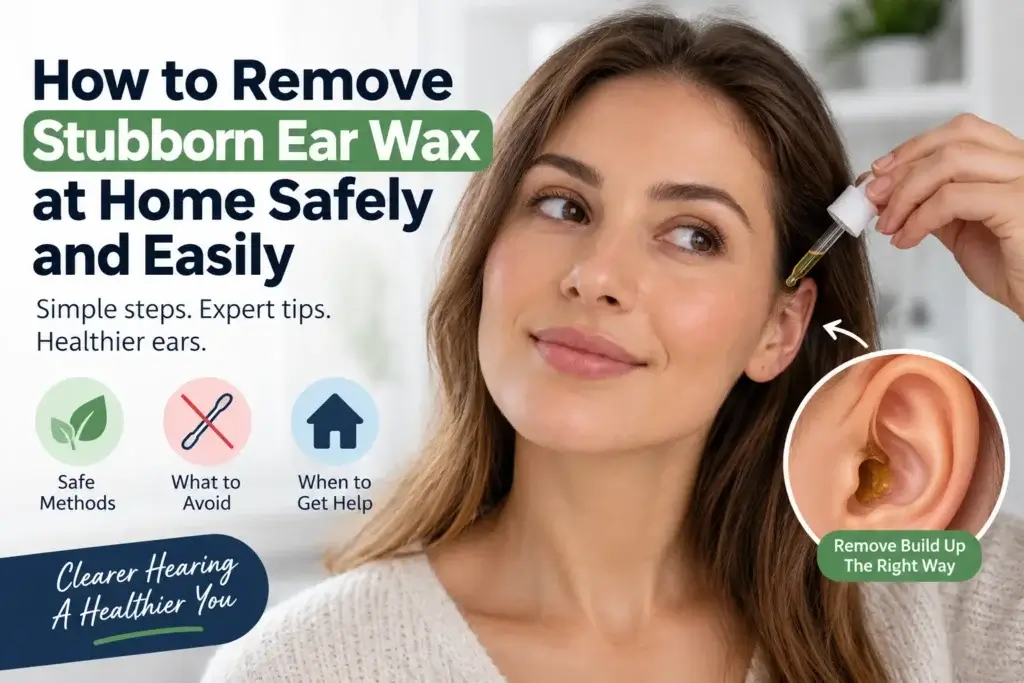
If your ear feels blocked, itchy, or a little muffled, there is a good chance mild earwax buildup is behind it. In our clinic, we see this almost every week. Learning how to remove stubborn earwax at home is easier than most people think, and in many cases some gentle care at home is all you need. But here is the honest part first. Not every blocked ear is right for home treatment, and wax that has become stubborn or properly impacted sometimes needs a pharmacist or GP to take a proper look.
What Is Earwax and Why Does It Build Up?
Earwax is a natural substance made by glands in the outer part of your ear canal. Rather than being something to get rid of completely, a healthy amount actually protects your ear from dirt, water and small particles, and it has some natural antibacterial properties too.
Your ears are, for the most part, self-cleaning. Tiny hairs and the everyday movement of your jaw slowly shift old wax and skin cells towards the outer ear, where it dries out and falls away without you having to do a thing.
Build-up usually happens when that natural process slows down or gets interrupted somewhere along the way. A few common reasons for this include:
- Narrow or oddly shaped ear canals
- Regular use of earplugs, headphones, or hearing aids
- A lot of hair in the ear canal
- Certain skin conditions
- Getting older, since wax tends to become drier and harder with age
- Repeatedly using cotton buds, which usually pushes wax deeper rather than clearing it
Some people simply make more wax than others. That is not a fault, just how their ears work.
Can You Really Remove Stubborn Ear Wax at Home?
Often, yes. Mild to moderate wax buildup can usually be softened and helped out with a few simple steps at home. Stubborn or impacted wax that has hardened and packed tightly into the canal is different, and it will not always shift, no matter how patiently you try.
If you have been softening it for several days and nothing has changed, or your ear still feels sore, blocked or uncomfortable, that is your cue to stop and let a pharmacist take a look, rather than pushing on with home remedies. Home care works well on wax that is soft enough to move. It is far less reliable on wax that has hardened.
How to Remove Stubborn Ear Wax at Home Safely?
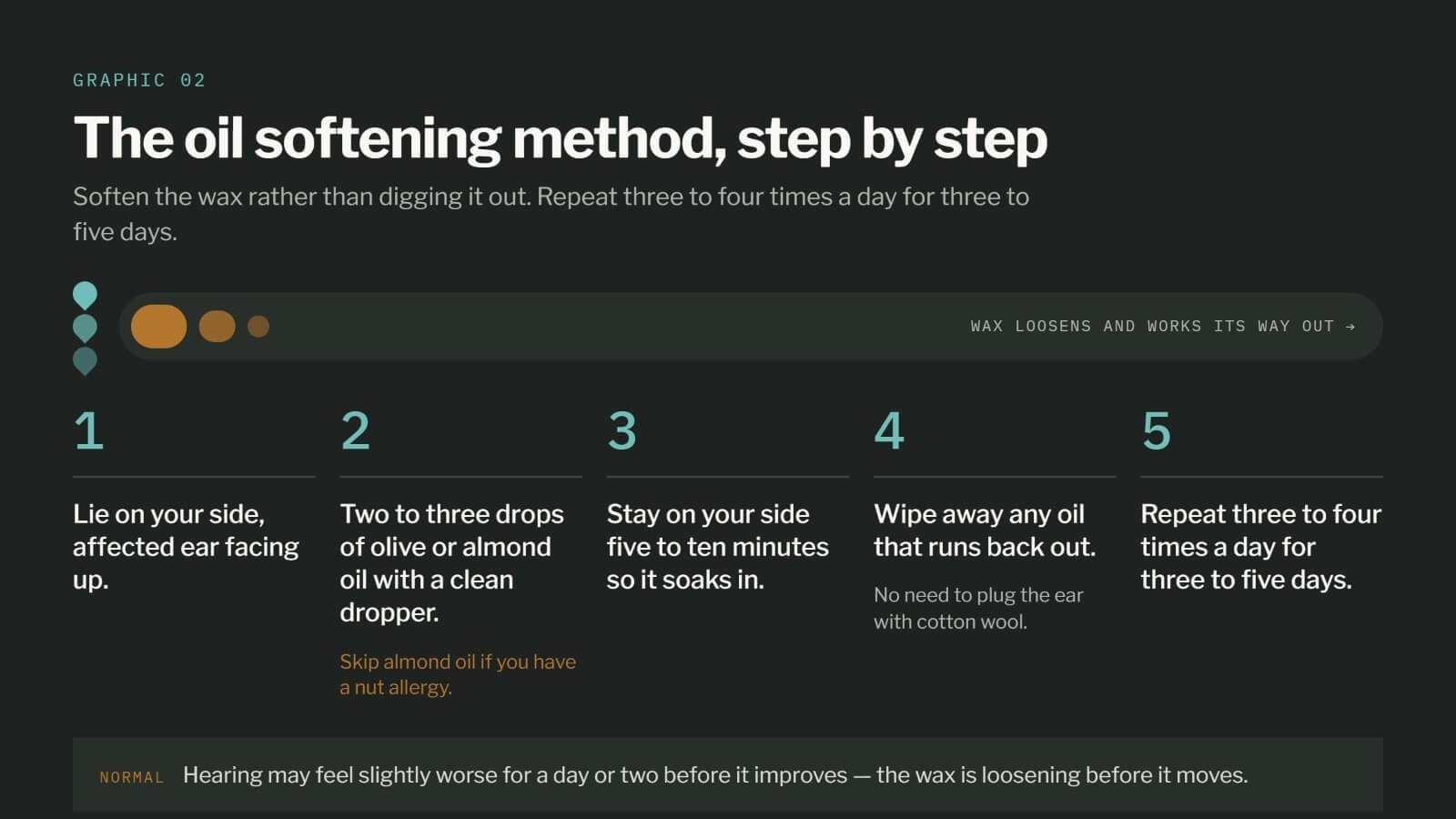
The approach we recommend most often is softening the wax rather than trying to dig it out yourself, following NHS guidance on earwax build up. This gives it a chance to loosen naturally and work its own way towards the outer ear, where you can wipe it away.
A method worth trying looks something like this:
- Lie on your side with the affected ear facing upwards.
- Put two to three drops of olive oil or almond oil into the ear canal using a clean dropper. Skip almond oil if you have a nut allergy.
- Stay on your side for around five to ten minutes so the oil has time to soak in.
- Wipe away any oil that runs back out. You do not need to plug the ear with cotton wool afterwards.
- Repeat this three to four times a day for around three to five days.
Over roughly two weeks, softened bits of wax should start coming away on their own and any blocked feeling should ease off. If you would rather use something from the pharmacy, wax softening drops or sprays work in much the same way, so just follow the instructions on the box.
A couple of things worth knowing before you start:
- Your hearing might feel a touch worse for a day or two after starting oil drops, before it gets better. That is normal and just means the wax is loosening before it moves.
- If both ears need treating, it often helps to do one at a time rather than trying to lie on both sides in one go.
Do not use oil drops if you have, or think you might have, a perforated eardrum, an active ear infection, or you have recently had ear surgery. If you are not sure, ask us first.
The Mistake We See Most Weeks
We had a patient come in recently with one ear completely blocked after a fortnight of daily cotton buds, followed by three days of oil drops. The oil had softened the outer wax nicely, but underneath it there was a hard plug the buds had compacted against the eardrum, and the drops were never going to reach it. Microsuction cleared it in about ten minutes.
That pattern, buds first and drops second, is behind most of the stubborn ears we see. The buds create the plug, and the drops then only treat the soft layer sitting on top of it. If you have been using buds, stop for a week before judging whether the drops are working.
Can You Remove Ear Wax Blockage Fast With Water?
There is a real difference between letting warm water run over your outer ear in the shower, which is harmless, and deliberately flushing water into the ear canal to force wax out, which is not something we would recommend doing yourself.
Ear irrigation, as this second method is called, can work well, but it needs to be done by someone trained, using the right equipment and the right amount of pressure. Get it wrong, and you can push wax further in, irritate the canal, or in rare cases damage the eardrum. If you are hoping to clear a blockage fast with water, the safer route is to soften the wax with oil drops over a few days first, then get any wax that will not budge removed professionally rather than reaching for a syringe yourself. Patience with the drops usually beats a rushed flush.
How to Clean Wax From Your Ears at Home
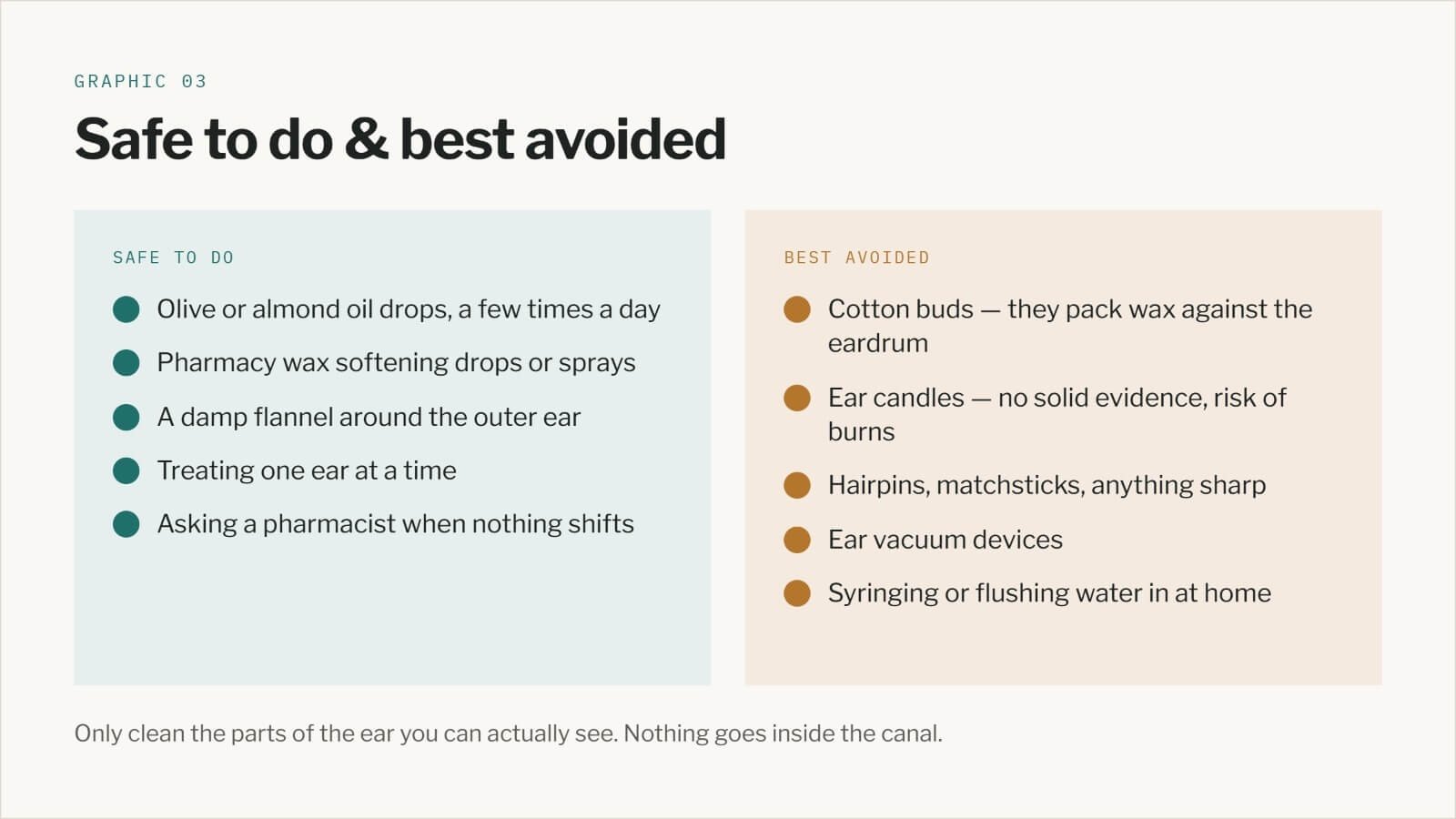
There is a simple rule that makes ear cleaning far easier and safer. Only clean the parts of the ear you can actually see. A damp flannel or cotton pad wiped gently around the outer ear and the entrance of the canal after a bath or shower is fine, and honestly all most people ever need.
What you should not do is put anything inside the canal itself to try to clean it out. It does not need scrubbing, and doing so tends to get in the way of the process that would otherwise clear wax on its own.
What Should You Avoid When Removing Ear Wax?
The RNID is clear that you should never put anything into your ear canal. A few habits keep coming up when people describe how a small amount of wax turned into a bigger problem than it needed to be. Steer clear of:
- Cotton buds. They almost always push wax further in rather than out, and can pack it tightly against the eardrum.
- Ear candles. There is no solid evidence that these remove wax, and there is a genuine risk of burns or dripping wax getting into the ear.
- Hairpins, matchsticks, or anything sharp. These can scratch the delicate skin of the canal or injure the eardrum.
- Ear vacuum devices. Much like candles, evidence that these work is thin, and some can be too forceful for the ear canal to handle.
- Cleaning tools bought online with no real backing. Without training, it is easy to misjudge depth and pressure.
- Forceful home irrigation with syringes or bulbs. This carries the same risks as unsupervised irrigation mentioned above.
If any of these sound familiar, it is worth switching to gentle softening drops instead. Getting this part right matters just as much as the softening steps themselves, since undoing bad habits often clears the way for softening to actually work.
When Should You Not Remove Ear Wax at Home?
Home treatment is not the right fit for everyone, and there are times when it makes sense to speak to us or your GP before trying anything yourself. Hold off and get advice first if you have:
- Ear pain, especially if it is sharp or getting worse
- Discharge or bleeding from the ear
- Signs of infection, such as swelling, heat or an unpleasant smell
- Sudden hearing loss
- Dizziness or balance problems
- A known or suspected perforated eardrum
- Had ear surgery recently
- Symptoms that persist or get worse despite trying softening drops
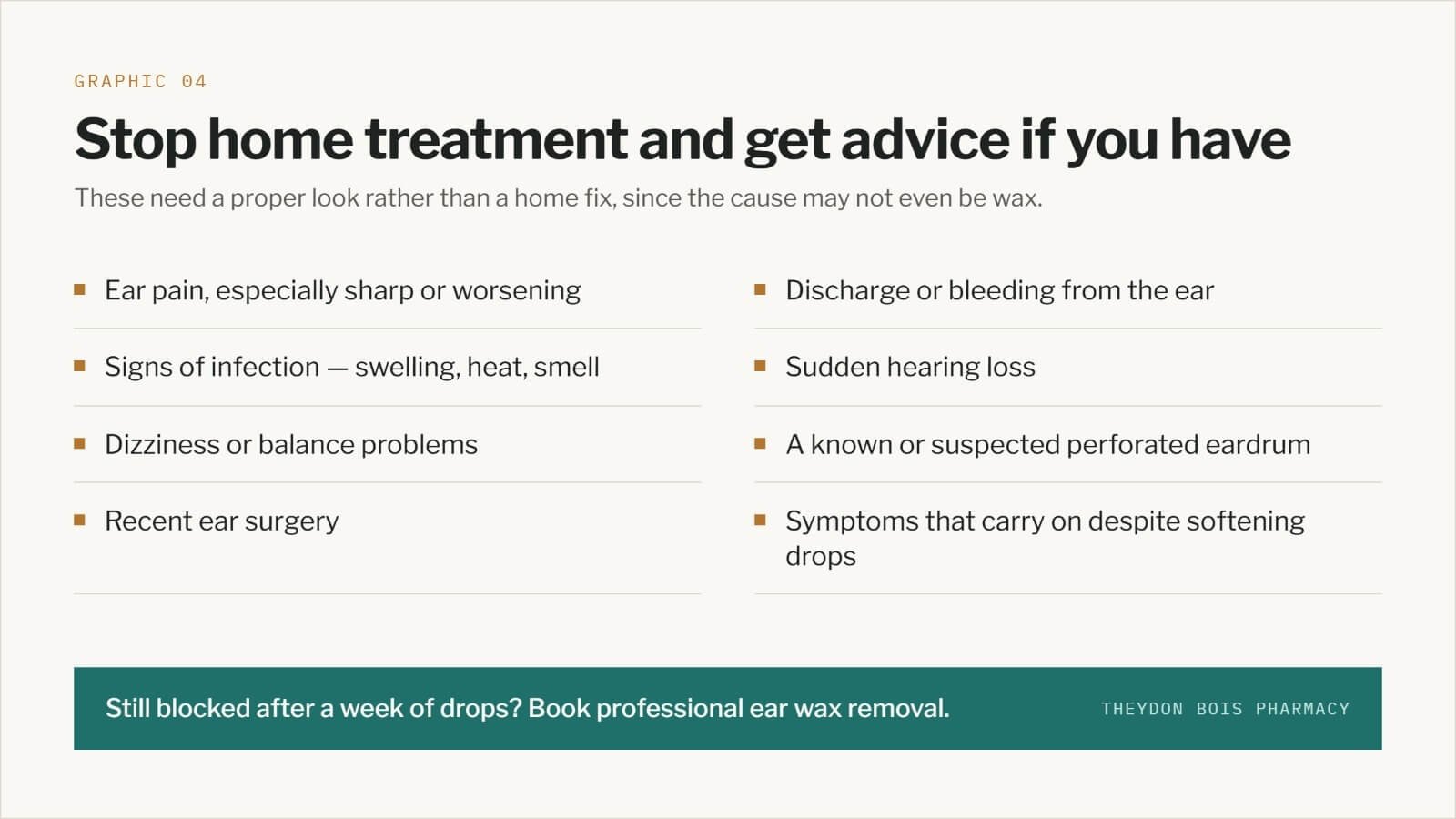
These need a proper look rather than a home fix, since the cause may not even be wax.
How Do You Know If Ear Wax Is Impacted?
Impacted earwax tends to show up as a cluster of symptoms rather than just one thing on its own. Common signs include:
- A blocked or full feeling in the ear
- Muffled or reduced hearing
- Mild discomfort or itching in the canal
- Ringing or buzzing, sometimes called tinnitus
- Sound feeling louder or echoing in the affected ear
It’s easy to assume any of this is down to wax, but the same symptoms can point to other things too, such as an ear infection or fluid behind the eardrum. If softening drops do not help within a few days, or anything about your symptoms feels a bit off, it is best not to assume it is wax and get it checked instead.
Comparing Your Options: Drops, Irrigation and Microsuction
| Method | Best For | Who Performs It | Not Suitable If |
| Softening drops | Mild to moderate wax that is still soft enough to move on its own | You, at home | You have a perforated eardrum, an active ear infection, or recent ear surgery |
| Ear irrigation | Wax that has already been softened but still needs help clearing | A trained clinician with the right equipment | You have a history of ear infections, a perforated eardrum, or the wax is hard and impacted |
| Microsuction | Stubborn or impacted wax, including wax that has not responded to drops | A trained practitioner using a gentle suction device | Rarely unsuitable, though a quick check first is best if your canal is unusually narrow or sensitive |
When Should You Get Professional Ear Wax Removal?
If you have given softening drops a proper go, and your ear is still blocked, sore, or affecting your hearing, that is a good time to book a professional ear wax removal service. The NICE quality standard on earwax removal states that adults with symptomatic wax should have it removed in primary care or a community service.
Professional removal is also the better choice if you have any of the warning signs above, since a trained clinician can check the canal and eardrum properly before doing anything else.
Stubborn or impacted wax that just will not shift on its own is genuinely common, so there is no need to keep battling on with cotton buds or endless bottles of oil. A quick look from someone trained to examine ears usually sorts it out fast. Home care gets most people most of the way there, and a short professional appointment finishes the job.
What Is Earwax Microsuction?
Microsuction is a technique trained professionals use to remove earwax with a small, gentle suction device under good lighting, often with magnification so they can see exactly what they are doing. It does not use water, which makes it a useful option for people who cannot have traditional irrigation.
Because the practitioner can see straight into the canal the whole time, microsuction tends to be well tolerated by most people, though experiences can differ from person to person. It is not guaranteed to feel completely comfortable for everyone, and it will not automatically be the right choice in every case, so a quick chat with our team beforehand helps make sure it suits you. Learn more on our earwax microsuction clinic in Essex page before booking.
Our Ear Wax Removal Service
We know how uncomfortable, and honestly quite annoying, a blocked ear can be, especially once you have already tried drops at home with little luck. Our team at our ear wax removal clinic in Theydon Bois offers a straightforward service for anyone who needs a bit more help than home treatment can give.
We take the time to have a proper look at your ear before deciding what suits you best, rather than assuming one method works for everyone.
If getting to us is not easy, we also offer home visit ear wax removal across Epping, Loughton and Chigwell, so you can get the same careful care without leaving home.
How to Prevent Ear Wax Build-Up
You cannot stop your ears making wax, and you would not really want to anyway, since it does a genuinely useful job. What you can do is lower the chances of it building up to an uncomfortable level:
- Keep cotton buds and other objects out of the ear canal
- Use softening drops now and then if you know you are prone to build-up, following the product instructions
- Take extra care if you wear hearing aids or earplugs often, since these can push wax further in
- Get recurring blockages checked rather than repeatedly treating them yourself without much improvement
Some people will always be a bit more prone to build-up than others because of how their ear canals are shaped. That is something to manage over time rather than fix once and for all, and a little prevention now will save you the same hassle the next time it builds up.
Get Help With Stubborn Ear Wax
If your ear has been blocked for a while, home softening has not quite done the trick, or you would simply rather leave it to someone trained to handle it, our team at Theydon Bois Pharmacy is happy to help. We will take a proper look, talk through what suits your ear best, and get you back to hearing clearly without the guesswork.
Ear wax removal costs £50 for one ear or £90 for both ears. If we take a look and there is no wax to clear, you only pay the £20 otoscopy fee and nothing more. Same-day appointments are usually available, so you do not need to wait around with a blocked ear.
Call us on 01992 812130 or book online with our ear wax removal clinic in Theydon Bois today, and let us take the stubborn wax off your hands.
Book an Appointment with our pharmacy team today and let us take the stubborn wax off your hands.
Frequently Asked Questions
How to remove stubborn ear wax at home?
The safest home approach is softening the wax with olive oil or almond oil drops a few times a day for several days, then letting it fall out on its own. If it has not cleared within a week or so, we can advise on what to try next.
How can I remove ear wax blockage fast?
There is no quick fix that is also safe. Softening drops used consistently for a few days work faster and more safely than trying to force wax out, and professional removal is the fastest route for wax that has not responded to home care.
Can I extract earwax at home?
Softening wax and letting it come out naturally is reasonable for mild buildup. Digging it out with fingers or tools is not advised, since it tends to push wax deeper or damage the canal.
When should I see a professional for ear wax removal?
If softening drops have not helped after about a week, or you have ear pain, discharge, sudden hearing loss, dizziness, or a suspected perforated eardrum, it is time to book professional removal with us.
Is microsuction suitable for stubborn ear wax?
Often yes, since it can reach wax that has not responded to softening drops without using water. Suitability varies from person to person, so a quick assessment beforehand is the best way to know for sure.